The Strange Brands in Your Instagram Feed shopify store 2
A new breed of online retailer doesn’t make or even touch products, but they’ve got a few other tricks for turning nothing into money.
His success finding an audience seems predicated on the fact that when he says he’s going to show you everything, he really is going to show you everything. Like, you will watch his screen as he goes about setting up a store, so anyone can follow along at home. He’s a Bob Ross of e-commerce.
These techniques work the same for him as for Gucci. Some Instagram retailers are legit brands with employees and products. Others are simply middlemen for Chinese goods, built in bedrooms, and launched with no capital or inventory. All of them have been pulled into existence by the power of Instagram and Facebook ads combined with a suite of e-commerce tools based around Shopify.
The products don’t matter to the system, nor do they matter to Ganon. The whole idea of retail gets inverted in his videos. What he actually sells in his stores is secondary to how he does it. It’s as if he squirts hot dogs on his ketchup and mustard.
What Ganon does is pick suppliers he’ll never know to ship products he’ll never touch. All his effort goes into creating ads to capture prospective customers, and then optimizing a digital environment that encourages them to buy whatever piece of crap he’s put in front of them.
And he is not alone.
The touchstone investigation into this world—“There’s No Such Thing as a Free Watch”— was conducted by an artist, Jenny Odell. After a visitor to Oakland’sMuseum of Capitalism brought a watch that was “sold” “free” online, Odell endeavored to seek out its origins. The watch was sold by Folsom & Co, one of a constellation of nearly identical companies selling nearly identical watches. These companies are distinguished primarily by their loose relationship with the truth about themselves. The information they provide about the brands is almost certainly fictional. While Folsom & Co claimed to be from San Francisco’s Soma district, SoFi coastal claimed to be from Miami. Both were probably from somewhere else. Another site creates the barest sketch of a supposed founder named “Bradley” who “had a constant desire to present himself well but didn’t believe fashion and style should come with such a high price.” Bradley probably doesn’t exist.
Of course, this is merely a hackneyed version of what all branding does, Odell points out. It creates stories that pump up the value of products. What you can charge depends on the story you tell, which on Instagram means well-lit photos in coffee shops lead directly to higher prices, especially if they feature an “influencer” with a lot of followers.
These new retail sites are also creatures that could only exist in our current economy. They are a reshuffling of the same fast-fashion infrastructure that powers H&M and Zara. West Louis and Folsom & Co are a new a front-end for the Asian factories that make stuff. Stumble onto one—or more likely—find yourself targeted by such a brand’s ads, and you open up one of many highly disposable faces of the globalized economy. It’s just that with companies like West Louis, the seams show, literally and figuratively.
* * *
Ganon’s videos are particularly fascinating in describing the mechanics of digital advertising through Instagram and Facebook.
In the tutorial, he briefly discusses finding a niche for the products in your store, and he uses some business school powerpoint terms. But when he actually selects a niche, it is Lions. That’s right: Lions, the animals.
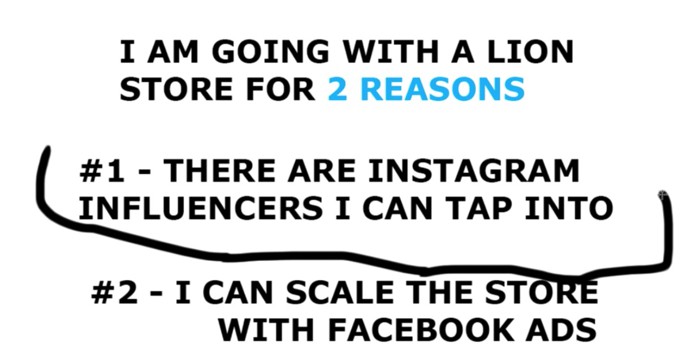
His reasoning, laid out in video two, is twofold. One, there are plenty of “Instagram influencers”—which is to say popular accounts—who he can pay to run an ad for his store because there are a bunch of “naturey” sites. And two, when he looks at Facebook’s Audience Insights tool, he (and anyone else) can see how large Facebook estimates the audience for certain interests might be. When he types in “lions,” “[Facebook] says I have 5 to 6 million monthly active people I can target,” he says. “But if I add in wildlife, you can see I have 10-15 million monthly active people I can show my ads to. So, if my store is successful, I can scale my store to thousands of dollars per day.”


Aucun commentaire:
Enregistrer un commentaire